CSR and events: creating responsible corporate events
Published on 2 April 2019
For CSR and events to go hand in hand, all it takes is the right approach to design an event consistent with its objectives.
CSR (Corporate Social Responsibility) is a notion that increasingly permeates companies’ daily lives, through various social and environmental initiatives in their activities and in their relations with the company’s stakeholders.
Corporate events are no exception. The events industry is even something of a pioneer, being the first to have adopted a specific standard governing the responsible approach: the ISO 20121 standard.
Choice of venue: the environmental impact of transport
Sustainable thinking begins with the choice of the venue that hosts the event. Far from negligible, CO2 emissions linked to the transport of people in fact account for a significant share of an event’s overall emissions.
Various solutions can be considered to limit the environmental impact: setting up an organised car-sharing system, shuttles, or even choosing to hold the corporate event in the company’s own city! In Paris, for example, various exceptional venues host seminars and corporate events, as is the case with the Cercle LeBrun (up to 420 people) and the Cercle d’Aumale (up to 350 people).
Besides transport, the choice of venue can also be guided by its energy performance. Those that have recently been renovated are often more likely to offer optimal environmental performance. The Cercle LeBrun, for example, is fitted with geothermal energy for its heating and cooling system. This ecological, renewable energy allows our venue to reduce its greenhouse gas emissions.
If the event requires accommodation, the hotel’s standards must also be taken into account. To find out the details, the best approach is to contact the venue operators, who can provide the various standards in force at their establishment.
Choice of suppliers: social and environmental commitment
A corporate event often involves calling on many suppliers: stands, equipment, on-site communication, catering, and so on. Their selection can also follow a CSR-oriented approach.
For equipment, stands, decorations and other on-site communication items, it is better to opt for suppliers offering eco-designed products, with a waste recovery or even recycling approach.
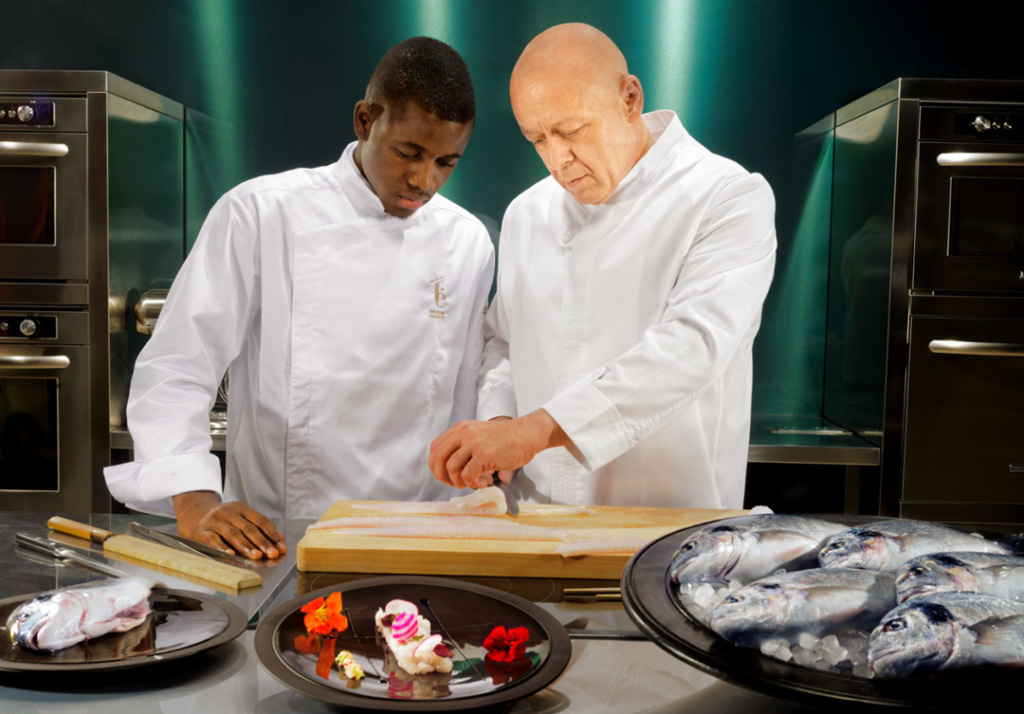
As regards food, it is also possible to make sustainable choices for your event. Some caterers offer to work with seasonal, organic, local or fair-trade products, for example. It is also worth asking suppliers what happens to unconsumed food: can it be taken away at the end of the event? Is it given to food banks or other charities? The By Kadrance label has chosen to establish a Caterer charter which explains, for example, that the venue prohibits the use of disposable plastic tableware and containers at events.
Besides the ecological dimension, it is important to be in tune with suppliers’ social approach, in particular by looking at their policies on hiring, training, reintegration and non-discrimination.
Involving employees
Designing a professional event with a CSR approach also means making guests aware of this commitment. They can be involved from the design stage of the event to strengthen buy-in to the project and ownership of CSR issues.
During the event, various awareness-raising activities can be devised, for example an Olympiad with a prize donated to a charity, or an awareness workshop on a responsible theme. These activities are an opportunity to make CSR accessible to everyone, as it can seem far removed from day-to-day concerns for some employees.
The venue’s layout and signage can also be awareness-raising tools. Besides ensuring that facilities are accessible to any colleagues with reduced mobility, signage can be put in place to encourage participants to adopt more responsible behaviour (putting waste in the bin, using the stairs, etc.).
CSR and events: how do you take stock?
After organising a corporate event with a CSR approach, how do you take stock and assess its impact? Useful tools exist to help you:
- The tool http://www.evenementresponsable.fr/, created by the “Collectif pour des événements responsables” with Ademe. It assesses the environmental impact of an event but does not really address the social aspect.
- The collaborative platform https://www.ecovadis.com/fr/ carries out comprehensive analyses and assessments of Corporate Social Responsibility.
In this field, it is impossible not to mention Béatrice Eastham, founder of the consultancy Green Événements which specialises in sustainability strategy in the events sector. The firm offers training, consultancy and help in obtaining ISO 20121 certification for companies. It is important to note that real awareness is currently taking hold and that the purchasing departments of large groups are also increasingly sensitive to the notion of CSR.
Interested in organising an event with a CSR-oriented approach? You can contact our teams via the “Contact” section of the site for advice and recommendations for your project.